

Contents:
- Why These Five Bathroom Floors
- The Best Flooring for Bathrooms, Ranked
- Waterproof vs Water-Resistant
- How to Choose Waterproof Bathroom Flooring
- Common Mistakes to Avoid
- Frequently Asked Questions
- What is the best budget bathroom floor?
- Can laminate go in a bathroom?
- Is tile or luxury vinyl better?
A tile may only call itself porcelain if it absorbs 0.5 percent or less of its own weight in water. That number explains why some bathroom floors last decades while others swell or grow mold within years. Choosing the best flooring for bathrooms is really a lesson in how materials behave around water, and box labels do not always tell the whole story.
Why These Five Bathroom Floors
A bathroom floor faces three kinds of water: surface splashes, standing water and vapor from steamy showers. Around Tampa Bay, humidity stays high for months, so that vapor dries slowly. The five materials below cover the full range of behavior: some cannot be harmed by water, some have a waterproof surface over a vulnerable core, and one always reacts to moisture. The top three are categories Tampa Bay Floor Stores carries and installs; the last two are included for honest comparison.
The Best Flooring for Bathrooms, Ranked
- Luxury vinyl plank and tile (LVP/LVT). A wear layer and printed design sit over a rigid stone-polymer (SPC) or wood-polymer (WPC) core with no wood fibers to swell. The planks are fully waterproof, warmer and quieter than tile, and roughly $2 to $7 per sq ft nationally. Seams still need caulked edges. Browse plank and tile styles, floating or glue-down, under vinyl flooring in Tampa, FL.
- Porcelain and stone tile. Porcelain is fired until nearly glass-like, so water has nowhere to go. Stone has tiny pores and needs a penetrating sealer reapplied periodically; the matte, textured and embossed stone finishes Tampa Bay Floor Stores stocks grip far better than high gloss. Grout must be sealed. Expect about $3 to $15 per sq ft, a cold surface and slower installation.
- Waterproof-rated laminate. The core is high-density fiberboard, compressed wood fibers that swell permanently when wet. Newer products add coatings and tight joints, and some resist standing water for roughly 24 to 72 hours. Fine for half baths, about $1.50 to $5 per sq ft. See glue-down and click-lock styles at https://tampabayfloorstores.com/catalog/laminate-floors/.
- Sheet vinyl. Wide rolls cover a small bath with almost no seams, at about $1 to $4 per sq ft. It dents easily and looks less realistic. Not in Tampa Bay Floor Stores’ catalog; best for rentals and utility baths.
- Engineered hardwood. A real wood veneer over a stable base handles humidity better than solid wood, but splashes and wet mats still cause cupping and stains. Not recommended near a tub or shower; wood-look vinyl gives the look without the risk.
Waterproof vs Water-Resistant
These terms are often confused. A waterproof material, like porcelain or rigid-core vinyl, survives prolonged contact. A water-resistant one, like traditional laminate or engineered wood, handles a quick spill but fails if water lingers. Even a waterproof plank is not a waterproof floor system: water running through seams can reach the subfloor. Samuel Okonkwo-Reyes, an independent certified flooring inspector, explains: “Most bathroom floors I inspect didn’t fail because the planks were bad. Water found the edges. A waterproof product only protects you if the perimeter is sealed and the subfloor was dry and flat when it went down.”
How to Choose Waterproof Bathroom Flooring
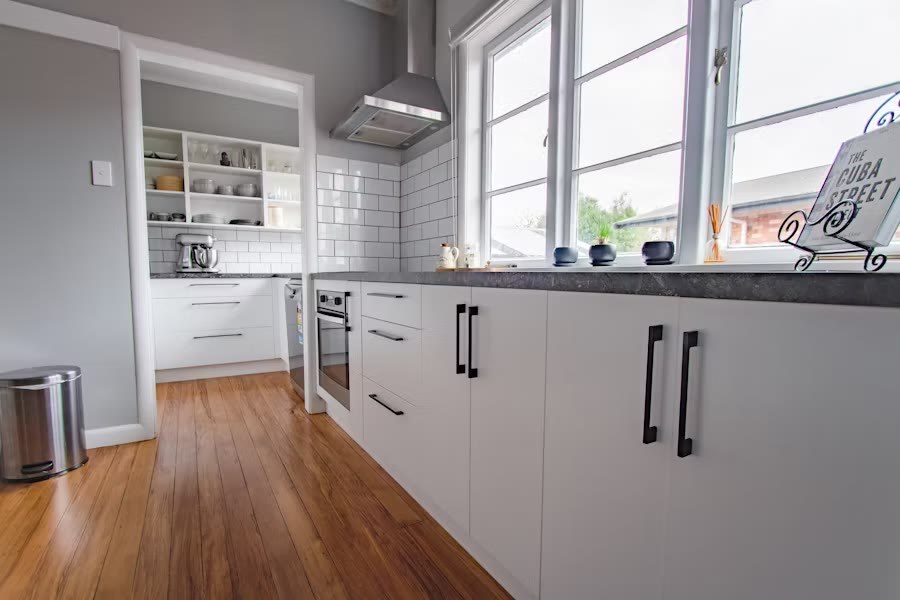
Rank water exposure first: a primary bath with two daily showers points to vinyl or porcelain, while a powder room allows laminate. Check the subfloor, since Florida slabs can wick moisture and upstairs wood subfloors suffer leaks; both must be flat. Favor matte or textured surfaces for wet feet. At the St. Petersburg showroom of Tampa Bay Floor Stores you can compare samples side by side, and their own installers handle subfloor preparation after a free estimate. Start at tampabayfloorstores.com.
Common Mistakes to Avoid
- Trusting “waterproof” without asking whether the core, surface or whole system is protected.
- Leaving gaps unsealed at the tub, shower and toilet flange instead of using mold-resistant silicone.
- Installing over a damp, untested or uneven slab, then living with a musty smell.
- Choosing polished tile or skipping a working exhaust fan.
Frequently Asked Questions
What is the best budget bathroom floor?
Rigid-core luxury vinyl offers the best mix of price and true waterproofing.
Can laminate go in a bathroom?
Water-rated laminate can work in a lightly used half bath, but its core still swells if soaked.
Is tile or luxury vinyl better?
Both are waterproof. Tile lasts longer; vinyl is warmer, quieter and faster to install, which Tampa Bay Floor Stores can show you in person.